
Should You Buy a Former Police Car? What to Check

A former police car is not just a cheap version of a normal used car
A retired police vehicle can look unusually attractive on paper. The purchase price may be low, the mechanical specification may include heavy-duty cooling, brakes or electrical capacity, and the maintenance history may be more structured than it is for some privately owned cars. But the odometer tells only part of the story. Police vehicles can spend long periods idling, carry electrical loads while stationary, experience repeated short trips and hard acceleration, and live a duty cycle that has little in common with an ordinary commuter car.
That does not make every former police car a bad purchase. It makes the purchase a different kind of underwriting problem. You are not asking whether the model is generally reliable. You are asking whether this specific vehicle's service history, assignment, idle time, decommissioning work and present condition justify the discount. The deeper the discount, the more evidence you should demand before calling it value.
Table of Contents
A former police car is not just a cheap version of a normal used car
First identify what kind of police work the vehicle actually did
Engine hours and idle time deserve more attention than buyers usually give them
Heavy-duty hardware is useful, but it is not a warranty against wear
Maintenance records can turn a risky story into an analyzable one
Decommissioning quality can matter as much as mechanical maintenance
Inspect the chassis as though the car has lived a harder life than the mileage suggests
The interior tells you about duty cycle, not just cosmetic condition
Price the car against other ex-fleet vehicles, not a clean civilian twin
Insurance, registration and remaining police equipment should be verified before money changes hands

First identify what kind of police work the vehicle actually did
“Ex-police” is too broad to be useful. An administrative or supervisor vehicle can have a very different life from a marked patrol unit. A highway vehicle may accumulate substantial road mileage at steady speeds. A city patrol unit may combine idling, curb strikes, repeated braking, short bursts of acceleration and constant entry and exit. A special-service vehicle may have carried equipment or spent long periods operating while parked. Two vehicles with the same year and mileage can therefore have very different wear histories.
Ask the seller or agency what the vehicle was assigned to do and whether that history can be documented. A credible answer is useful evidence; a vague answer is not automatically disqualifying, but it increases uncertainty. When the use history is unknown, price the car as an unknown-duty vehicle rather than assuming the best-case story.
Engine hours and idle time deserve more attention than buyers usually give them
Current police vehicles are explicitly engineered around the reality that law-enforcement equipment must often remain powered while the vehicle is stationary. Ford, for example, describes Police Engine Idle and hybrid systems designed to support electrical loads during police use. Earlier Ford material also highlighted how much of a police shift can be spent at idle. The exact pattern varies by agency and assignment, but the implication for a used buyer is straightforward: mileage alone is an incomplete measure of use.
If the vehicle records engine hours or idle hours, retrieve them. Do not convert those hours into a universal “equivalent mileage” figure and pretend the result is precise; wear depends on engine design, temperature, maintenance, operating conditions and how the vehicle was driven. Instead, use the hours as a second odometer. High idle time should make you more interested in oil-change history, cooling-system condition, battery and charging history, accessory loads, engine smoothness and diagnostic data.
Heavy-duty hardware is useful, but it is not a warranty against wear
Police packages are often purpose-built. Depending on the model and configuration, they may include upgraded cooling, higher-capacity electrical systems, different brakes, wheels, tires, suspension calibrations or interior equipment. Those components exist because the duty is demanding. Buyers sometimes reverse that logic and assume the heavy-duty specification means the car cannot have been worn hard.
Treat the hardware as capability, not immunity. A stronger cooling system does not erase neglected fluid service. Heavy-duty brakes can still be worn. Reinforced seats and easy-clean interiors can still reveal years of constant use. A pursuit-rated chassis may have been driven over curbs, medians or rough shoulders. The fact that a vehicle was designed for severe service is a reason to inspect the severe-service areas carefully, not a reason to skip the inspection.
Decommissioning quality can matter as much as mechanical maintenance
When a police vehicle leaves service, radios, computers, partitions, emergency lighting, sirens, antennas, consoles and other equipment may be removed. The quality of that work varies. Look for cut wiring, open connectors, drilled holes, poorly sealed antenna mounts, altered trim, missing console pieces, warning lights, parasitic battery drain and electrical accessories that no longer behave as intended.
Water intrusion deserves particular attention where roof or body equipment was mounted. So does the fuse and wiring area. A vehicle can drive perfectly during a short test while still carrying a future electrical problem created by hurried equipment removal. If the car has extensive decommissioning work and the seller cannot explain it, have a technician familiar with electrical diagnosis inspect the vehicle before purchase.
Maintenance records can turn a risky story into an analyzable one
Fleet maintenance is one of the strongest arguments in favor of some former police cars. Agencies may follow scheduled service procedures and retain records that a private seller would never have. But “fleet maintained” is not enough as a phrase. Ask for the actual history. Look for oil and filter intervals, transmission and driveline service where specified, brake work, cooling-system repairs, battery and alternator replacement, suspension work, tire history, collision repairs and recurring diagnostic complaints.
Patterns matter. Repeated repairs to the same system can be more revealing than one expensive replacement. A recently replaced component can be positive if the underlying problem is resolved and documented. Gaps in the record matter more when the vehicle's duty cycle was severe. Your goal is not a perfect history; it is a history coherent enough to estimate the next several years of ownership.
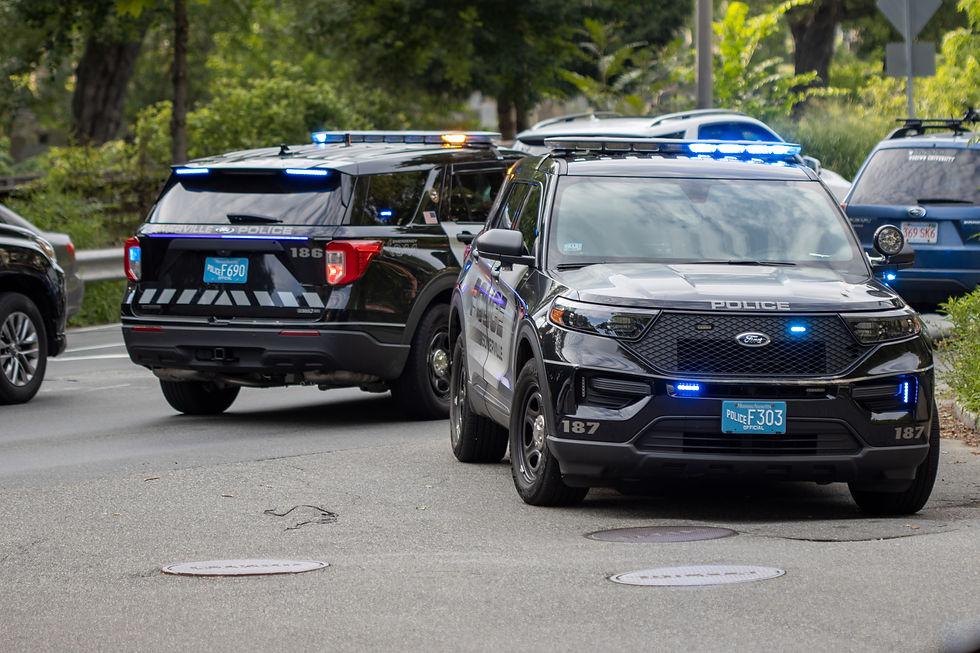
Inspect the chassis as though the car has lived a harder life than the mileage suggests
A used-car pre-purchase inspection is mandatory, but the emphasis should reflect police use. Check wheels and tires for impact evidence and uneven wear. Inspect control arms, bushings, dampers, wheel bearings and alignment. Look underneath for damaged shields, bent components, leaks and corrosion. Examine brake condition and signs of repeated heat. Test every drive mode and listen for driveline noise during low-speed turns and highway cruising.
On the road, pay attention to more than acceleration. Does the transmission engage smoothly from cold and hot? Does the steering track straight? Are there vibrations under braking? Does the engine maintain temperature normally? Does the charging system behave properly with accessories running? Scan all control modules for stored and pending faults, not only the engine computer. A clean dashboard is not the same as a clean diagnostic history.
The interior tells you about duty cycle, not just cosmetic condition
A plain vinyl rear seat or missing center console may be obvious, but subtler wear can reveal how the vehicle lived. Driver-seat bolster collapse, worn pedals, door-hinge looseness, steering-wheel wear and damaged seat-belt hardware can support or contradict the mileage story. Repeated entry and exit is part of patrol work. So is carrying equipment that can damage trim.
Decide which defects are acceptable before you bid or negotiate. Cosmetic austerity may be completely fine if your goal is inexpensive transportation. Missing civilian comforts may be annoying if you expect the vehicle to function like the retail version. Some police packages differ significantly in interior trim, sound insulation, rear-door operation, console layout or available convenience features. Verify the actual equipment rather than assuming the civilian brochure applies.
Price the car against other ex-fleet vehicles, not a clean civilian twin
A common valuation mistake is to see that the same year and model costs more as a normal retail vehicle and call the gap instant savings. The former police car is not the same product. Its duty history, equipment differences, cosmetic condition, narrower resale audience and decommissioning all affect value.
Compare it with other former police or severe-duty fleet examples where possible. Do not use a former rental car or off-lease car buying framework as a substitute; those histories deserve their own tests. Then subtract the cost of immediate maintenance, tires, brakes, missing trim, electrical repairs or other work the inspection identifies. Add a repair reserve appropriate to the vehicle's complexity and age. If the “bargain” only works when nothing breaks for the next two years, it is not conservatively priced.
Insurance, registration and remaining police equipment should be verified before money changes hands
Do not assume the administrative side will sort itself out after purchase. Confirm that the title and VIN are clear, that the vehicle can be registered normally in your state, and that your insurer will cover the exact vehicle and use. Emergency lighting, markings, sirens and other police-specific equipment may be restricted by local law even when the vehicle itself can be owned by a civilian. Requirements differ by jurisdiction, so verify the rules that apply where you live.
Also check open recalls by VIN and confirm that any agency or auction paperwork needed for title transfer is complete. A cheap vehicle that cannot be insured promptly, registered cleanly or legally operated in its current configuration is not a good deal.
Use the auction format as another risk signal
If you are buying through a government or surplus auction, understand exactly what the sale does and does not promise. Inspection access may be limited, test drives may be unavailable, and vehicles can be sold as-is. Read the condition notes, service attachments, title paperwork and pickup terms before bidding. Set a maximum price that already includes transport, taxes, immediate maintenance and the repair reserve your inspection access cannot eliminate. Competitive bidding can turn a sensible risk-adjusted purchase into an ordinary used-car price with extraordinary uncertainty. The discipline is simple: decide what the evidence supports before the bidding starts, then refuse to let auction momentum change the math.
When a former police car can make sense
The strongest candidate is usually a vehicle with a known assignment, coherent service records, reasonable engine-hour information, professional decommissioning, a clean diagnostic scan and an independent inspection that does not reveal deferred mechanical work. The buyer should also be comfortable with utilitarian trim and a smaller resale audience.
It can make particular sense for someone who values durability-oriented hardware more than luxury, can tolerate cosmetic imperfections, has access to a trustworthy mechanic and is buying at a price that leaves a genuine repair reserve. The discount must compensate you for uncertainty. If the price is only slightly lower than a comparable civilian vehicle, the trade-off becomes harder to justify.

When you should walk away
Walk away when the story shows serious used-car red flags. Unknown duty history, no meaningful records, very high idle hours combined with poor maintenance evidence, unresolved warning lights, transmission behavior that feels wrong, overheating, significant wiring damage, structural collision evidence or a seller who resists an independent inspection all move risk in the wrong direction.
The same is true when you are stretching your budget. A former police car is a poor place to spend every available dollar because the purchase case depends on your ability to absorb catch-up maintenance and unexpected repairs. If the only reason the car fits your budget is the auction price, you may be buying uncertainty you cannot afford.
The decision is about evidence, not the badge on the door
A retired interceptor can be a rational buy, a hobby purchase, or an expensive lesson. The difference is rarely whether “police cars are good.” It is whether the specific unit has enough evidence behind it to make its remaining life understandable.
Treat mileage, engine hours, assignment, maintenance, decommissioning, inspection findings and price as one package. A documented car with honest wear can be safer financially than a prettier car with an opaque history. WhatCarFitsMe's broader principle still applies: condition and use in context are more informative than a stereotype. Buy the vehicle in front of you, not the story attached to it.
Decision Matrix
Vehicle history | Potential advantage | Main risk | Evidence to demand | WCFM guidance |
Documented admin / supervisor use | May have lighter duty and structured fleet service | Still can have high idle time or fleet wear | Assignment history, hours, complete service records | Best ex-police profile when condition also checks out |
Documented patrol use | Purpose-built hardware and often strong records | Idling, braking, impacts and repeated short-cycle use | Idle hours, chassis inspection, brake and cooling history | Buy only when discount clearly pays for the added uncertainty |
Documented highway / pursuit use | May have more steady road mileage | High-speed duty, braking and drivetrain stress can vary | Assignment, maintenance, tires, brakes, diagnostic scan | Condition and records matter more than the pursuit label |
Unknown auction history | Low acquisition price may be possible | You cannot reliably price the duty cycle | Inspection access, title paperwork, diagnostics, repair reserve | Require the largest risk discount or walk away |
Frequently Asked Questions
Are former police cars reliable?
Some can be, but reliability depends heavily on the specific vehicle's assignment, engine and idle hours, maintenance history, decommissioning quality and present condition. Police-duty hardware can be robust, but severe use can also create wear that normal mileage does not fully describe.
Do engine hours matter when buying an ex-police car?
Yes. Engine and idle hours can add useful context because police vehicles may spend significant time running while stationary. Do not convert hours into one universal equivalent-mileage number. Use them alongside mileage, service records, diagnostic data and inspection findings.
Are police cars faster or more powerful than civilian versions?
Some police packages use different engines, cooling systems, brakes, suspension, tires, calibrations or electrical equipment, while others are closer to civilian versions. Verify the exact VIN, powertrain and factory specification instead of assuming every former police vehicle is a performance model.
Can civilians buy former police vehicles?
Former police vehicles are often sold to the public through auctions or dealers, but title, registration and restrictions on remaining emergency equipment vary by jurisdiction. Verify your state and local requirements, insurance eligibility and decommissioning status before purchase.
What is the most important inspection on a former police car?
A comprehensive pre-purchase inspection is essential, with extra attention to suspension and underbody damage, brakes, cooling, transmission behavior, electrical decommissioning, stored diagnostic faults, tire wear and service records. The inspection should reflect the vehicle's likely duty cycle, not just a normal used-car checklist.


