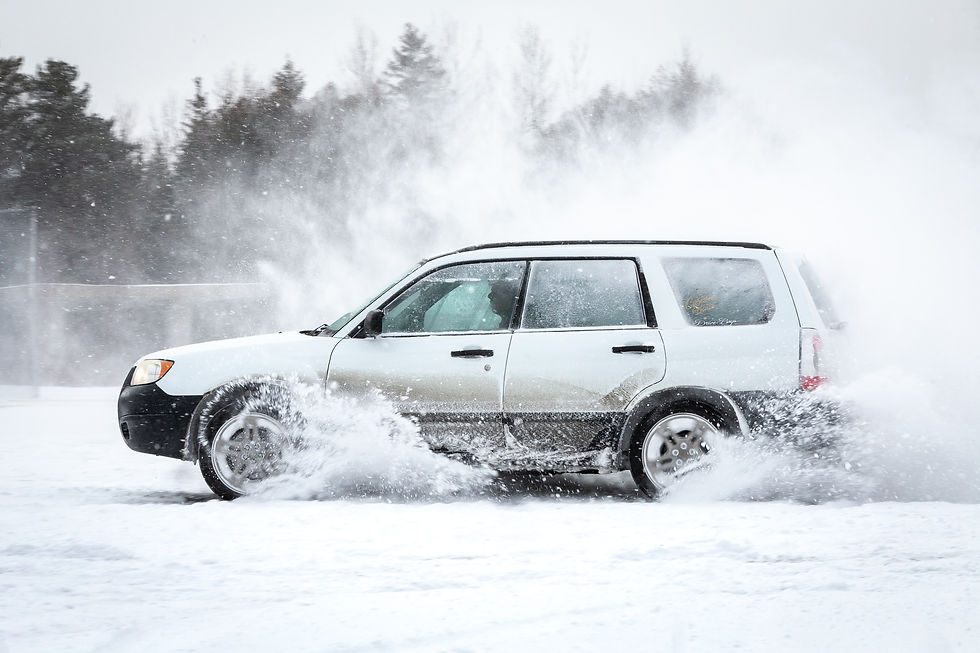
FWD vs AWD: Which Drivetrain Fits Your Life?

FWD vs AWD is not a weather badge
FWD vs AWD is often presented as a simple upgrade decision: front-wheel drive is the basic version, all-wheel drive is the safer or more capable version, and buyers who can afford the second option should choose it. That framing is too crude. Drivetrain changes how a vehicle puts power to the road, but it also interacts with tires, weight, efficiency, maintenance, purchase price and the roads you actually use.
The useful question is not whether AWD is “better.” It is whether the extra driven axle solves a recurring problem in your life often enough to justify its trade-offs. A commuter on flat, well-maintained pavement has a different traction problem from someone who climbs a steep unplowed road every winter. A buyer who occasionally visits a gravel trail has a different need from someone whose driveway turns muddy for weeks at a time.
At WhatCarFitsMe, the right drivetrain is the one that removes real friction without adding capability you rarely use. That means comparing two otherwise similar vehicles by your route, climate, tires, annual mileage, ownership horizon and budget—not by the badge on the tailgate.
Table of Contents

Start with traction exposure, not fear
A practical drivetrain decision begins with what we call traction exposure: how often low-grip conditions occur, how difficult they are, and what happens if the vehicle cannot move confidently through them. Frequency matters. Consequence matters. So does whether the problem is acceleration traction, stopping, ground clearance or simply poor tires.
AWD can help a vehicle distribute driving force across more tires and can make it easier to get moving on slippery or loose surfaces. It does not repeal the limits of tire grip, and it does not automatically shorten stopping distance. If your real concern is winter braking and cornering, tire quality and condition remain central. Our dedicated guide to whether AWD is necessary for snow goes deeper on that winter-specific question.
This distinction prevents a common buying error: paying for AWD to solve a problem that belongs to tires, clearance or driving conditions. The drivetrain is one part of the system, not a substitute for the rest of it.
Where FWD is often the cleaner fit
Front-wheel drive packages the engine and driven wheels at the front of the vehicle. In many mainstream cars and crossovers, that layout helps keep the vehicle simpler and lighter than an otherwise comparable AWD version. The exact differences in price, fuel economy and maintenance are model-specific, so compare the actual trims rather than relying on generic assumptions.
FWD is often a strong fit for buyers who spend nearly all of their time on paved roads, deal with modest weather, prioritize lower ownership cost, or drive enough annual miles that small efficiency differences matter. It can also free budget for things you use every day: better tires, a more suitable trim, driver-assistance equipment, a stronger maintenance history on a used car or simply a larger financial buffer.
A warm-climate commuter who encounters heavy rain but no sustained snow may gain little from automatically selecting AWD. A city driver who values tight parking, lower running costs and predictable service may reach the same conclusion. The point is not that FWD is universally preferable; it is that capability should earn its place in the budget.
Where AWD earns its keep
AWD becomes more compelling when low-grip starts are a recurring part of normal life rather than an occasional edge case. Regular snow, steep slippery grades, loose gravel, muddy access roads and some mixed-surface driving can make the additional traction genuinely useful. The value increases when failing to get moving would create a meaningful problem rather than a mild inconvenience.
The Consumer Reports overview of FWD, RWD, AWD and 4WD is useful because it treats drivetrain as a set of operating characteristics rather than a universal hierarchy. That is the right mindset for a buyer: understand what the system changes, then decide whether your roads actually require it.
AWD can also matter to buyers choosing higher-output vehicles where distributing power across four tires improves the way the vehicle accelerates. But that is a different use case from winter mobility, and it should not be smuggled into a practical purchase as a safety argument. Be precise about the job you are paying the system to do.
Tires can change the answer
The FWD vs AWD debate becomes misleading when tire condition is ignored. A vehicle can only use the grip available at the contact patches. Worn, inappropriate or poorly inflated tires can undermine the advantage buyers expect from a more complex drivetrain. Conversely, a well-maintained FWD vehicle on tires suited to its climate can be entirely appropriate for many drivers.
NHTSA’s TireWise guidance emphasizes choosing tires for the conditions where you drive and maintaining them correctly. For a buyer, that means the drivetrain budget and the tire budget belong in the same conversation. If choosing AWD leaves no room to replace marginal tires on a used vehicle, you may have improved the badge while weakening the actual system.
Our guide to choosing the right tires for your real life can be a better next step if the real question is seasonal grip rather than drivetrain architecture.
Compare the same model, not two stereotypes
The cleanest way to decide is often to compare FWD and AWD versions of the same vehicle or closely related trims. Look at the actual purchase-price difference, EPA fuel-economy ratings, tire sizes, ground clearance, curb weight, maintenance schedule, warranty coverage and standard equipment. Sometimes the AWD trim also bundles other features, which means the decision is no longer a pure drivetrain comparison.
Used-car shoppers should go further. Inspect service history and tire matching, listen for drivetrain noises, confirm there are no warning lights and understand any model-specific requirements for replacing tires in sets or maintaining similar tread depths. AWD adds components, and the condition of those components matters more than the theoretical capability of a neglected system.
Do not assume a used AWD vehicle is automatically the stronger buy than a cleaner FWD example. Condition, history and fit can overwhelm the drivetrain label. The best configuration on paper is still the wrong car if the specific vehicle has been poorly maintained.

Efficiency should be checked, not guessed
AWD often brings extra hardware and mass, which can affect fuel or energy consumption, but the size of the difference varies widely by model and technology. Some systems disconnect or reduce torque to one axle when it is not needed; others behave differently. EVs can add a second motor instead of a mechanical driveshaft. Hybrids may use an electric rear axle. Generic statements are less useful than the official ratings for the exact configuration you are buying.
For a high-mileage driver, even a modest efficiency difference can accumulate over years. For a low-mileage owner, the fuel effect may be less important than purchase price, tire replacement or the value of traction on a difficult route. Compare the complete ownership picture instead of treating one MPG figure as the decision.
This is the same principle behind buying for your real commute: recurring use deserves more weight than rare scenarios.
Ground clearance and AWD solve different problems
A vehicle can have AWD and still scrape, drag or become high-centered if it lacks the geometry for the road beneath it. It can also have generous clearance and still struggle to put power down if traction is poor. Buyers frequently bundle these ideas together because taller crossovers often offer both, but they are separate capabilities.
If your challenge is a steep driveway transition, deeply rutted lane or rough access road, clearance, wheelbase, tire sidewall and suspension may matter alongside drivetrain. If the issue is simply launching on a slick hill, AWD may be more directly relevant. Diagnose the obstacle before buying the solution.
That is also why you should not automatically jump to a larger SUV. Our guide to whether you really need an SUV helps separate body style from the specific capability you need.
Four real buyers, four different answers
Imagine a 20,000-mile-a-year highway commuter in a mild climate. Roads are paved and routinely maintained, snow is rare, and parking is easy. FWD may preserve efficiency and simplicity without giving up a capability the driver uses. The sensible upgrade budget could go to tires, comfort or a better vehicle condition instead.
Now imagine a family living on a steep road where winter storms regularly leave packed snow before plows arrive. Getting children to school or reaching work is not optional. AWD has a recurring job, and the cost may be justified even if the vehicle uses slightly more energy or requires more drivetrain attention over time.
A third buyer spends weekdays in the city and reaches a rough trailhead six weekends a year. AWD may help on loose surfaces, but the decision also depends on clearance, tires and how demanding those roads actually are. A smaller AWD crossover could fit; a heavy 4WD truck might be unnecessary.
A fourth buyer wants AWD because it feels like protection but lives in a warm, flat suburb and replaces tires only when they are nearly worn out. The better use of money may be to choose the right tires and maintain them earlier. Capability that exists in hardware but is undermined at the contact patch is poor value.
AWD is not the same as 4WD
AWD and 4WD are sometimes used casually as if they were interchangeable, but buyers should understand the system in the exact vehicle. AWD is commonly designed for transparent on-road operation and automatically manages torque between axles. Traditional 4WD systems are more often associated with trucks and off-road use and may include driver-selectable modes, locking behavior or low-range gearing.
If your life includes serious off-road terrain, towing on challenging surfaces or work that depends on low-range capability, FWD vs AWD may be the wrong comparison altogether. The relevant question could be AWD vs 4WD or which 4WD system fits the job. WCFM’s guide to choosing the right 4WD addresses that different decision.
Do not buy 4WD because AWD sounds insufficient, and do not buy AWD because 4WD sounds excessive. Define the task first, then choose the hardware.

Use a same-route test drive
A normal dealership loop may not expose the reason you are considering AWD. If possible, test the vehicle on the grades, broken pavement, highway entrances and parking situations that resemble your actual life. You are not trying to manufacture a skid or test the limits of traction. You are checking visibility, steering, ride, turning behavior, tire noise, power delivery and whether the vehicle feels composed in the environments you use most.
For two versions of the same model, pay attention to differences beyond drivetrain. Wheel and tire packages can change ride and road noise. Trim-level equipment can change the price. A higher-output engine may only be offered with AWD. The configuration you prefer may therefore be a bundle of decisions rather than one.
Write down which benefits you noticed and which exist only in theory. A feature that you cannot connect to a recurring use case should face a higher burden before it receives budget.
The WCFM drivetrain test
Before choosing FWD or AWD, answer five questions. How often do you face snow, steep wet roads, loose surfaces or mud? When those conditions occur, what is the consequence of reduced traction? Are your tires appropriate and will you maintain them? What is the exact cost and efficiency difference on the model you are buying? How long do you plan to keep the vehicle, and are you comfortable with the added system complexity?
If the answers show repeated traction exposure with meaningful consequences, AWD can be a rational fit. If the need is rare, the roads are predictable and your budget benefits from simplicity, FWD may be the stronger match. Neither answer is a downgrade when it is aligned with reality.
The best drivetrain is not the one with the most driven wheels. It is the one that solves your recurring road problem without forcing you to pay every day for a capability you almost never use.
Decision Matrix
Real-world use | FWD fit | When AWD adds value | Check before deciding | Common mistake |
Paved commute, mild climate | Often strong | Usually limited | Exact trim price and efficiency | Buying AWD as a default upgrade |
Frequent snow or steep slippery roads | Can work with the right tires and conditions | Often meaningful for getting moving | Tires, road treatment, grades and frequency | Assuming AWD also shortens stopping distance |
Gravel, mud or mixed surfaces | Depends on frequency and severity | Can be useful | Clearance, tires and route difficulty | Confusing AWD with serious 4WD capability |
High annual mileage | Often attractive for simplicity and efficiency | Worth it when traction exposure is recurring | EPA ratings and ownership horizon | Ignoring small recurring cost differences |
Performance-oriented use | Vehicle-specific | Can improve power delivery | Exact system and tire package | Calling a performance benefit a safety necessity |
Frequently Asked Questions
Is AWD safer than FWD?
Not universally. AWD can improve the ability to put power down and get moving on low-grip surfaces, but tire grip, speed, braking and road conditions still determine much of the safety picture. Evaluate the complete vehicle rather than treating AWD as a safety guarantee.
Does AWD use more fuel than FWD?
Often an AWD version carries extra hardware and mass, but the size of the efficiency difference varies by model and technology. Compare the official ratings for the exact FWD and AWD configurations you are considering.
Do I need AWD for rain?
Rain by itself does not automatically make AWD necessary. Good tires, correct inflation and sensible speed are fundamental. AWD may add traction value in some conditions, but the decision should reflect how often your routes are genuinely traction-limited.
Is FWD good enough for snow?
It can be for many drivers, depending on snow depth, road treatment, hills, tire choice and driving frequency. WCFM’s separate winter guide explains when AWD adds enough value to justify its cost.
Is AWD more expensive to maintain?
AWD adds drivetrain components, but actual maintenance schedules and repair exposure are model-specific. Check the exact vehicle’s service requirements and condition rather than applying one universal cost assumption.
Can AWD replace winter tires?
No drivetrain can create grip that the tires do not have. If your climate calls for winter tires, AWD should be considered alongside them rather than as a substitute.